




At this year’s UN climate summit in Antalya, Türkiye, Amrita University led a session on November 10, 2026 titled “From Sensor to Settlement: Operationalising University-Led Disaster Risk Reduction and Locally Led Climate Resilience”. The theme reflected COP31’s wider push to move from pledges to implementation.
Dr Maneesha V Ramesh, Pro-Vice Chancellor of Amrita and UNESCO Chair on Experiential Learning for Sustainable Innovation & Development, chaired the roundtable at the YÖK Pavilion, hosted by Türkiye’s Council of Higher Education. Dr Raghu Raman, Amrita’s UNESCO Co-Chair on Assistive Technologies in Education, opened the session.
Participants stressed that solutions are most urgent where climate change is already a daily reality. Floods, landslides, cyclones, glacial lake outbursts, and extreme heat are hitting communities across South Asia, Southeast Asia and the wider Global South harder and more often, and adaptation is high on the COP31 agenda.
When we try to love or serve without understanding those whom we are serving, we often end up harming society and ourselves.
Amma
As Chancellor of Amrita University, Amma expressed in a video message that science, technology, and spirituality must unite in order to ensure a sustainable existence for our world. The wellbeing of our planet demands this transformation.
“At present, mankind lives solely depending on science and technology, but in light of our current situation, we should at least try to incorporate spiritual thinking as well. Recently, we have witnessed so many natural calamities and alarming changes in the global climate, including rapidly increasing global warming. We need to ponder deeply on whether human effort alone will be enough to put a halt to the imminent worldwide catastrophe,” Amma said.
She added that the actions of each one of us reverberate throughout creation, whether we know it or not. To ensure the future of all, we must start by focusing on those at the base of the socio-economic pyramid. She told the story of villages where Amrita students and faculty taught a group of people in each place about toilet building, and then left the construction to them. But the community members did not use the newly built toilets, as the habit of going to the local lake or river was deeply ingrained.
“At this point, we began educating the villagers, explaining that open defecation leads to water and soil pollution, which further contaminates our food and leads to all kinds of parasitic infections such as hookworm. This helped in creating the much-needed awareness in the community,” explained Amma.
“When we try to love or serve without understanding those whom we are serving, we often end up harming society and ourselves. In order for service to be beneficial, it needs to go hand in hand with discernment. This is the essence of sustainable development.”
Dr Maneesha’s team at Amrita built one of the world’s first wireless sensor networks for landslide detection, in Munnar, Kerala in 2009, and later extended it to Sikkim in 2015. She spoke about what it takes to turn a sensor reading into action: reliable technology, local authorities who trust the data, and communities who know what an alert means.
People with disabilities, who are often left out of climate planning, were the emphasis of Dr Raghu’s remarks. A warning works only if everyone can receive and understand it, he said, which means alerts in voice, text, and sign language. He also pointed to the potential of artificial intelligence, used responsibly, to make warnings more accessible.
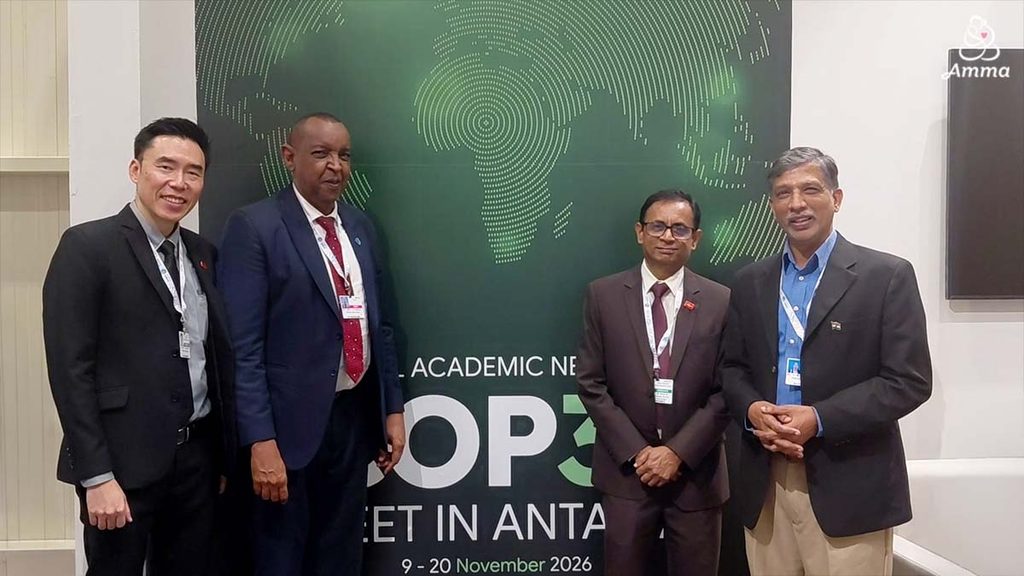
Other speakers included Dr Senaka Basnayake, Program Lead for Climate Services at ADPC in Bangkok; Dr Dhiraj Pradhananga, UNESCO Chairholder in Mountain Cryosphere and Water at Tribhuvan University, Nepal; Dr Peeranan Towashiraporn, Director of the Asian Disaster Preparedness Center; and Ibrahim Rashid Ahmed, a Senior Presidential Advisor from Kenya.
The session closed with a shared commitment to keep working across borders. Speakers agreed that universities are well placed to build and test the technology, train students and responders, and stay with communities for the long term. Participants discussed closer links with national disaster agencies and sharing open technology and training across the Global South.
As COP31 negotiators work through the details of adaptation, finance, and implementation in the coming days, the message from the YÖK Pavilion was simple. Early warnings save lives only when they reach every person, in every village, in time. Universities are ready to help make that happen, in the spirit of solidarity.