


Amma’s Ashram in Pune is a powerful expression of her vision of education for all, through both spiritual and intellectual knowledge. Here the Brahmasthanam Temple stands beside an Amrita Vidyalayam, one of her network of schools, on ground where learning has opened ever wider over the ages.
In the Early Vedic period, Sage Agastya journeyed across this land, carrying oral Sanskrit learning through the region’s river valleys. In the 17th century, Sant Tukaram sang the deepest truths of the Vedas in his Marathi abhangs, so that ordinary people could experience the eternal truth in their mother tongue. And in 1848, at Bhide Wada, Jyotirao and Savitribai Phule opened the first girls’ school founded and run by Indians, open to students of every caste.
Truth has many sides
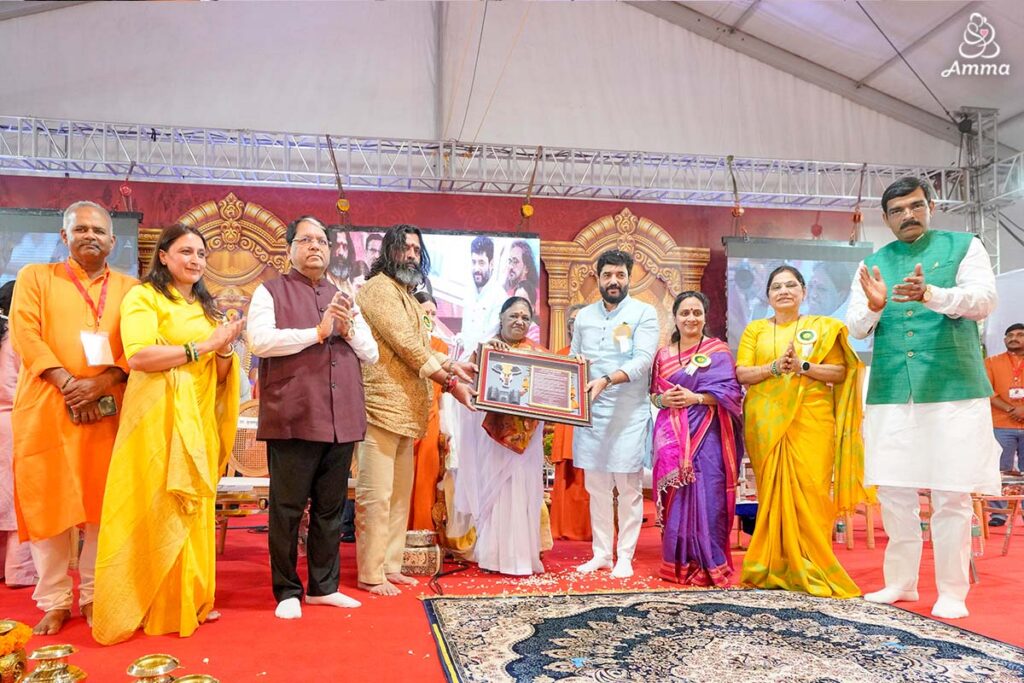
On the morning of November 14th, Amma’s Brahmasthanam Festival began with a lifetime achievement award for Amma, given by another sector of society who shares knowledge. The Marathi Patrakar Sangh, the association of Marathi journalists, stated that journalists always seek the truth, and Amma is the truth of goodness.
“Just as it is our job to criticise bad things, bringing forward good things in society and honouring them is also our job,” said Kiran Joshi, State President, Marathi Patrakar Sangh.
“Two years ago, when we went to meet Amma, we stopped at a tea stall. After the tea, the topic of Amma came up. The chai-wallah asked, ‘Are you going to meet Amma?’ I said, ‘Yes.’ Then he didn’t take money from us for the tea. He gave us a bunch of bananas. ‘The Amma who built homes for us, you are going to meet that Amma. Through you, our hands service will reach Amma’s feet.’”
Journalists have a great role in upholding dharma in society.
Amma
Union Minister of State for Civil Aviation, Shri Murlidhar Mohol, presented the award and a letter of honour to Amma during the programme. He expressed that Pune was a land of saints, and today, a saint had come to them.
“Supporting those in distress, that is true dharma, as our saints taught. Amma’s life is a living example of this thought. She connected spirituality with social service, and gave compassion the form of a people’s movement,” he said.
“Sant Tukuram sang the mantra of true divinity: ‘Je ka ranjale ganjale, tyasi mhane jo aapule…’ One who calls the afflicted and oppressed their own… Against this backdrop, Amma’s coming here today is in alignment with his words.”
As is her way, Amma immediately returned the award to those who had given it, in this case those who serve society through the media.
“Amma is very happy to accept this award given by her children who are Marathi journalists. However, Amma’s greatest award is her children and the selfless service they render to the world,” she said, reflecting on the responsibility of journalism to present the truth to the public.
“Journalists have a great role in upholding dharma in society. May they carry out that work with sincerity, responsibility, a sense of dharma, and selflessness.”
Amma also spoke about the setting within which this knowledge unfolds, Maharashtra’s great spiritual and cultural heritage.
“Maharashtra is the land of many Mahatmas. Similarly, Shivaji and Sambhaji [the first two rulers of the Maratha Empire in the 17th-century] have given us shining examples of sacrifice and patriotism. The contributions these great personalities of Maharashtra have made to the culture and glory of Bharat are immense. May they inspire all of us.”
Sheetal Sudhakar Pawar, Executive Editor, Dainik Sakal (Marathi) later said, “I am meeting Amma for the very first time, yet I feel as if I am with my family.”
Each one of us contributes to the good of all
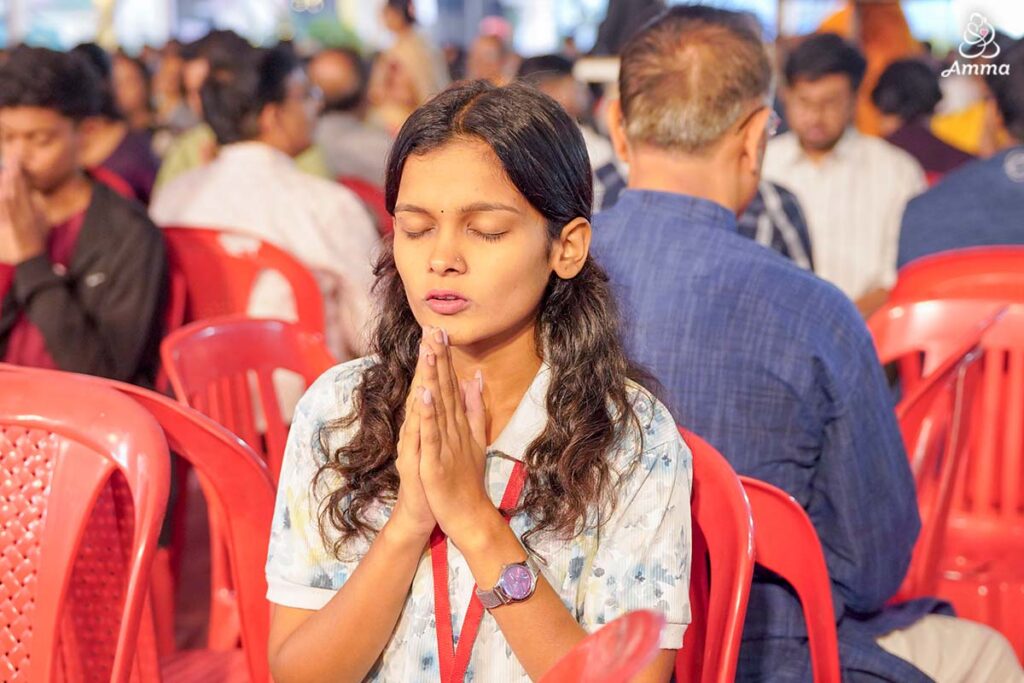
In her message, Amma spoke about the need to cultivate compassion and love towards nature, fellow human beings and all living creatures. She reminded everyone that our actions become good karma when we fulfill our dharma.
“Our sages taught us to perceive unity within diversity. From this perspective, there is no hatred or enmity, no sorrow or anger. Instead, one sees only goodness in everyone and everything,” said Amma.
Seven sacred rivers, one nation
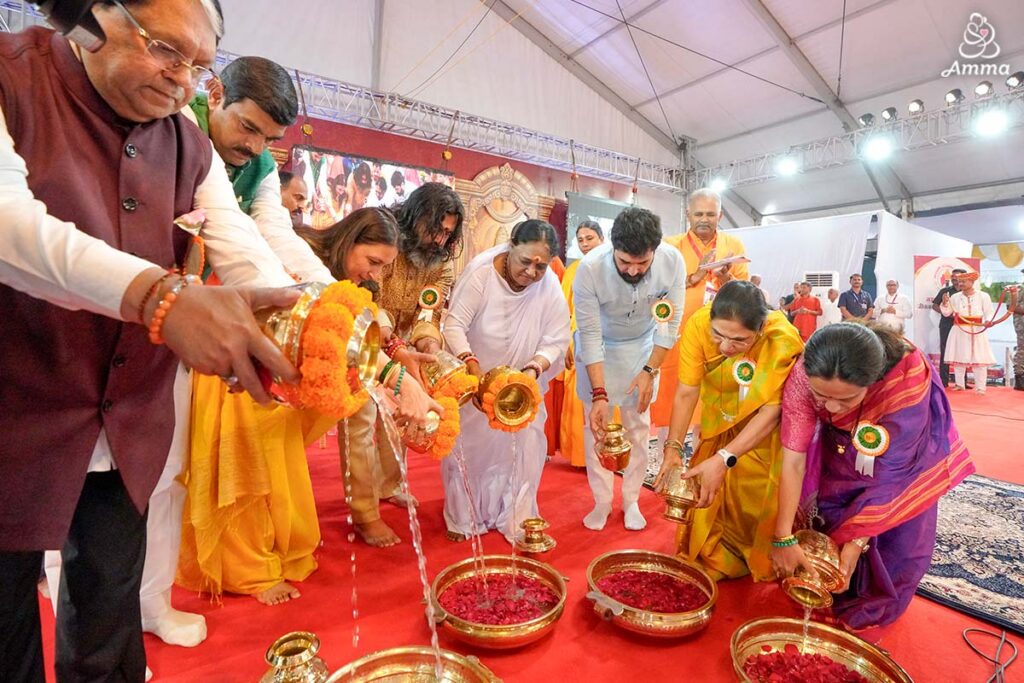
One of the most endearing scenes was a symbolic offering of the waters of Bharat’s seven sacred rivers, celebrating that unity in diversity. Amma, along with the dignitaries, tipped seven brass pots rimmed with orange marigolds towards the urulis filled with red rose petals. The clear waters merged into one as each pair of eyes watched with calm focus.
Maharashtra’s devotional traditions came alive with abhangs, songs of the Marathi poet-saints, as Amma was presented with a shawl and beautiful black statues of Lord Vitthala and Rukmini, deities deeply loved and worshipped in the region.
Young hearts taking responsibility
During the festival, members of AYUDH, Amma’s youth wing, took an anti-drug pledge, promising to stay away from intoxicants, discourage substance abuse by others, and help those who have fallen into addiction rehabilitate.
The AYUDHians in Pune also launched an initiative to support the education of children from economically disadvantaged families. These efforts reflected their commitment to putting compassion into practice.
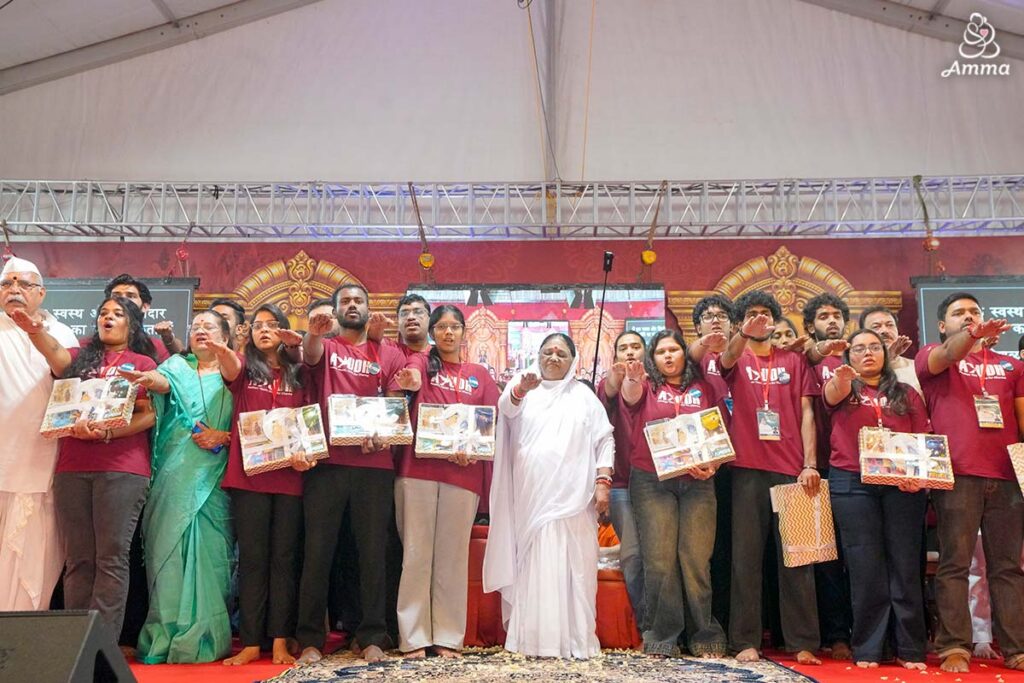
“Amma has given some students some gift hampers, which consist of educational and academic material that we are going to donate to underprivileged children in Ajanta Nagar. We are going to go there, donate these academic items, and also teach those kids, so that they will be able to learn more things and be self-sustainable,” said Mohini with AYUDH Pune.
Ajanta Nagar is a working-class neighborhood just minutes from the Ashram, home to many low-income families from the surrounding industrial belt. From 2002 to 2005, Amma built 11 blocks of five-storey apartment buildings for 700 families who lived in surrounding slums. It is the place that is home to the chai-wallah who gave free tea and bananas to Kiran Joshi with the Marathi Patrakar Sangh on his way to meet Amma for the first time.
Women’s self-help groups continue to rise
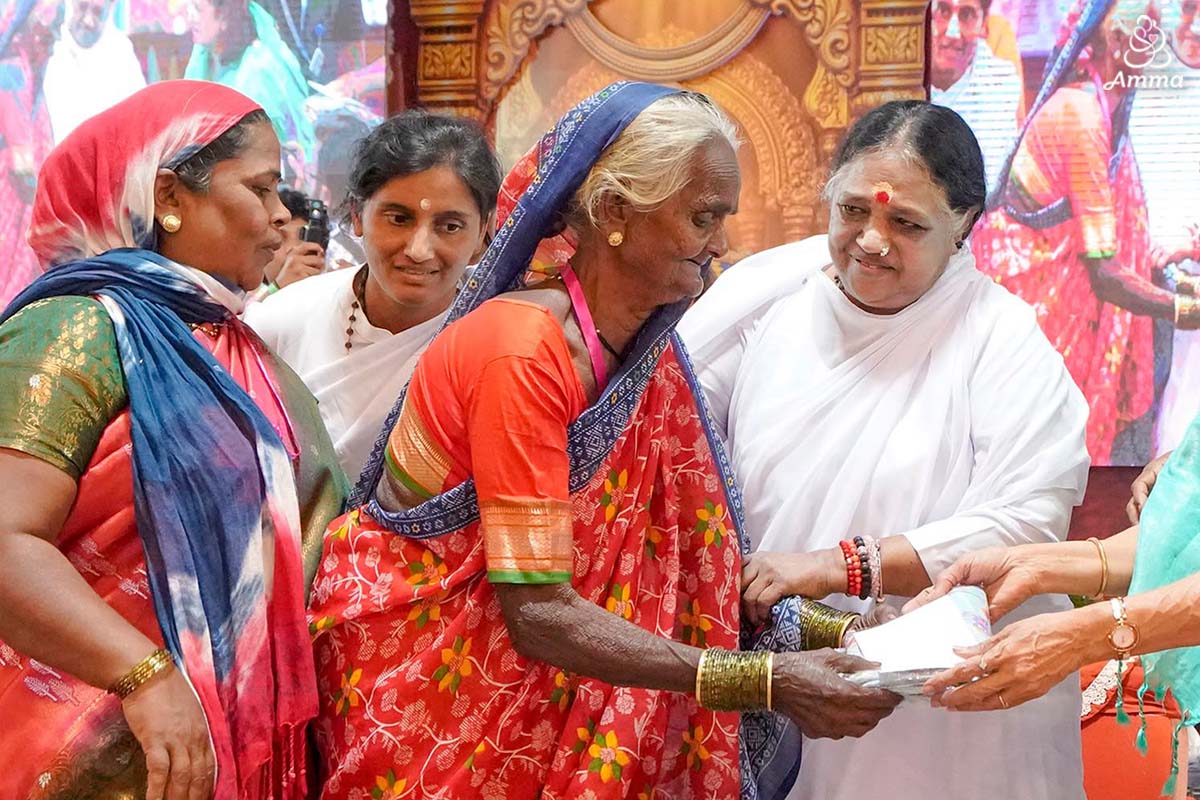
Then the women came forward, members of the AmritaSREE self-help groups, from the districts of Maharashtra. Each received a sari from Amma’s hands. The sari is a sign of her care, and what comes with it is a beginning. Every year, each group receives thirty thousand rupees from Amma, about 1500 for each woman, as seed money to start earning on her own.
Abhangs offered at Amma’s feet
Maharashtra has a long tradition of expressing devotion through abhangs, the devotional songs associated with saints such as Tukaram, Jnaneshwar, Namdev, and Eknath. This spirit of devotion was present throughout Amma’s Pune programmes. Two groups of musicians offered classical and semi-classical bhajans before Amma.
Among them was Avadhoot Gandhi, a Marathi devotional singer and spiritual storyteller, who sang abhangs for Amma. There is an interesting family tradition associated with Avadhoot Gandhi’s maternal lineage, connecting it with the story of Sri Krishna and Rukmini.
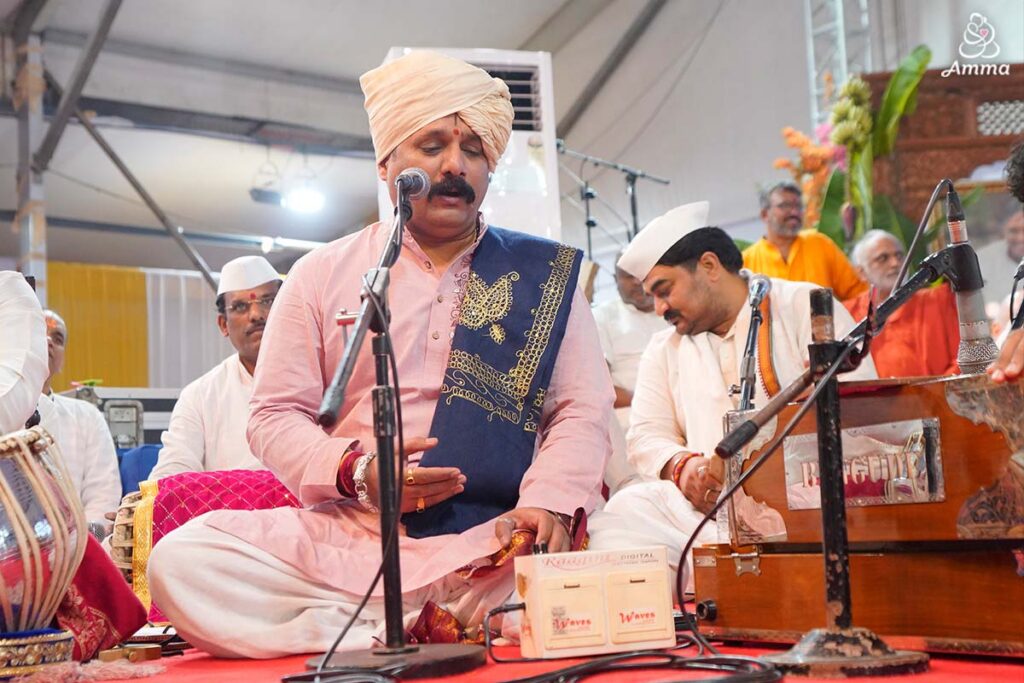
When Rukmini wished to marry Krishna against her brother Rukmi’s plans, she entrusted a secret letter to a Brahmin named Sudeva, who carried it to Krishna in Dwaraka. After their marriage, Rukmini offered Sudeva a reward. Rather than asking for wealth, he requested that his descendants be granted the privilege of performing her daily worship.
The family tradition holds that this privilege has continued through the generations at the Rukmini Temple in Pandharpur, and that Avadhoot Gandhi’s mother belongs to that lineage.
The story added another connection between the evening’s devotional music and Maharashtra’s living traditions of Krishna bhakti. A descendant of Sant Tukaram, Shivajirao Sadashiv More, belonging to the tenth generation of the saint’s family, also came to offer his respects to Amma.
A little butter, a lot of bhakti
Another touching moment brought back a cherished tradition of Amma’s visits to Pune. For many years, a devotee affectionately known as Kale Master would come with his family to worship Amma in the spirit of Krishna bhakti.
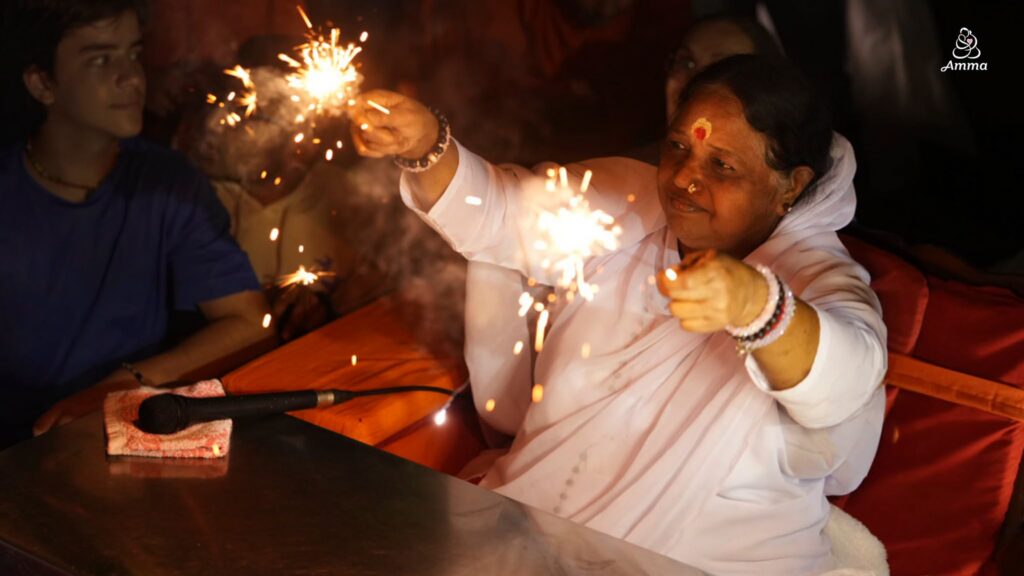
The family members would dress as gopis and bring pots filled with butter, curd and milk. Kale Master would lovingly decorate Amma as Krishna, with a crown, peacock feather and flute. Amma would playfully break the pots, taste their contents and distribute the prasad to the devotees.
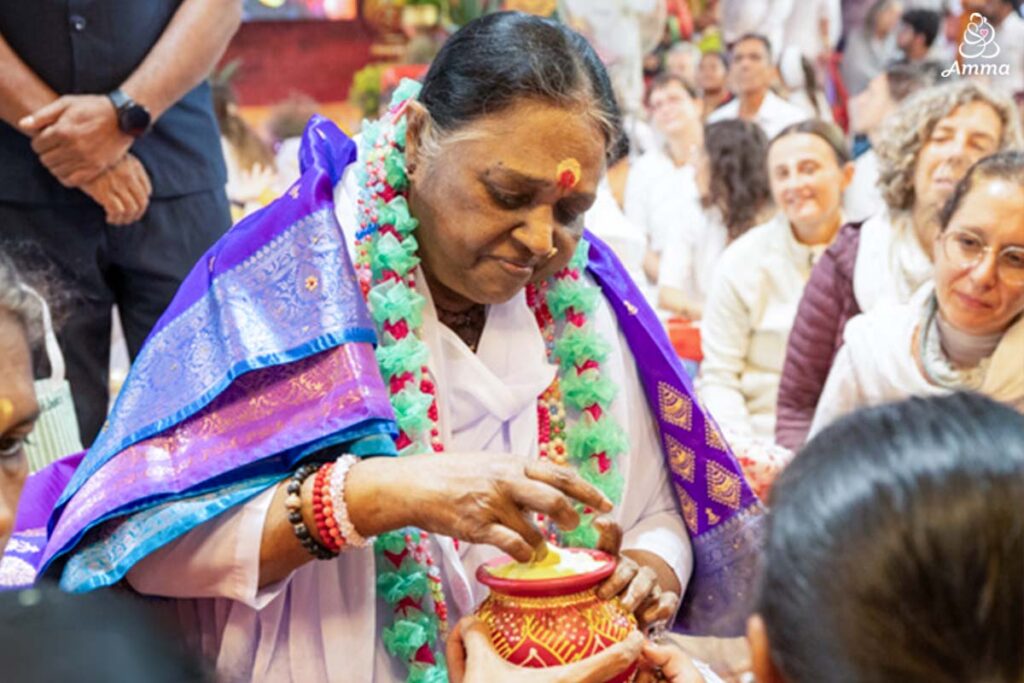
For the Pune devotees, these moments had become a much-loved part of Amma’s visits, bringing to life the innocent devotion of the gopis towards Krishna.
This time, Kale Master was not there to conduct the ceremony. But the family continued the tradition and came forward to offer butter to Amma. The simple offering carried the devotion of a family that had been associated with Amma’s Pune programmes for many years.
Many hands, one welcome
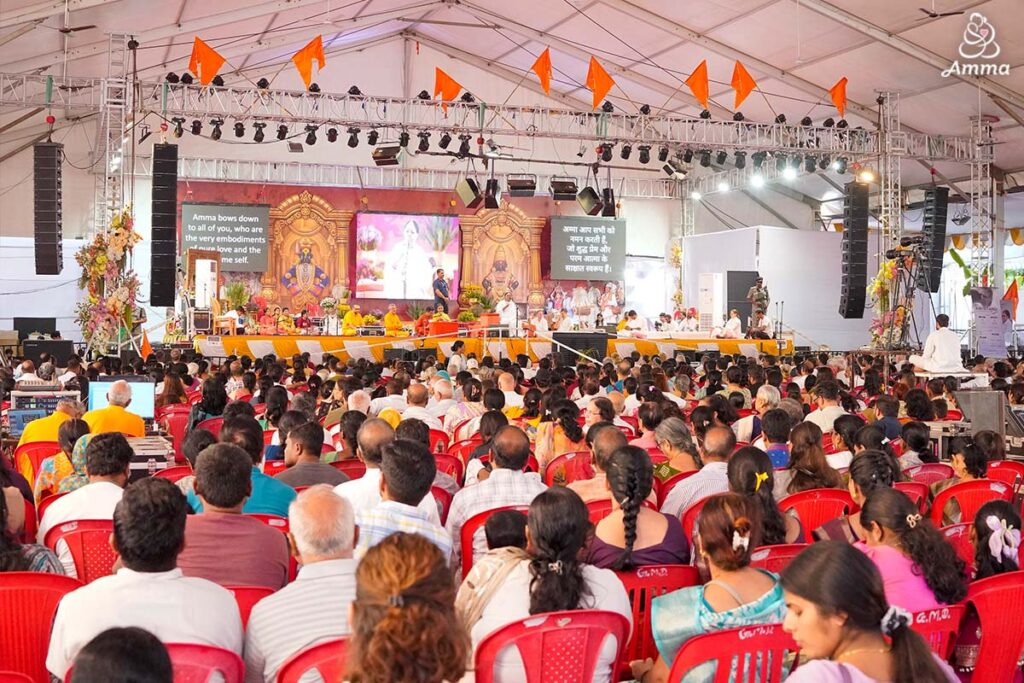
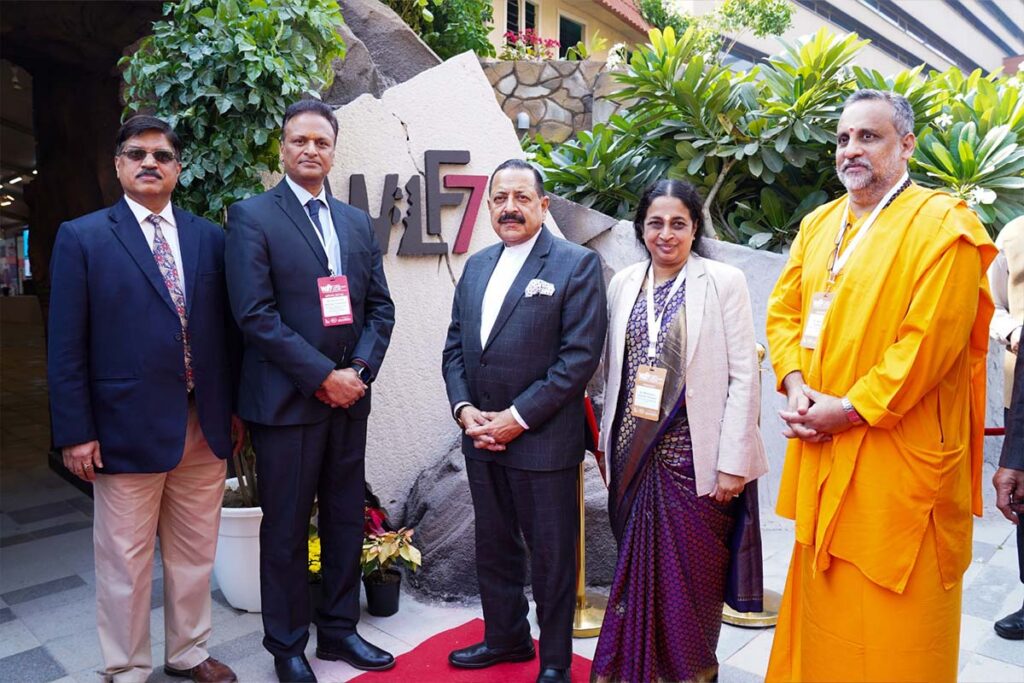
During the festival, many dignitaries graced the occasion. On the first day, Marathi Patrakar Sangh State President Kiran Joshi was accompanied by Bhosari MLA Mahesh Landge during the award ceremony, along with senior figures from Maharashtra’s media: Pudhari Media Group Chairman Dr. Yogesh Pratapsingh; Sakal Editor Sheetal Pawar; ABP Majha Editor Sarita Kaushik; Jai Maharashtra Editor Vrushali Kadam; and Daily Suraj Editor Rakesh Tolye. Also present were V.J. Developers CEO Aditya Javdekar; Kohinoor Group Chairman Krishnakumar Goyal; and BVG India Founder-Chairman Hanmantrao Gaikwad.
On the second day, Pimpri MLA Anna Dadu Bansode; Maharashtra MLC Uma Khapre; Shweta Shalini, adviser to the Maharashtra Deputy Chief Minister; and Symbiosis International (Deemed University) Vice-Chancellor Ramakrishnan Raman welcomed Amma with garlands.
Two days that will last forever
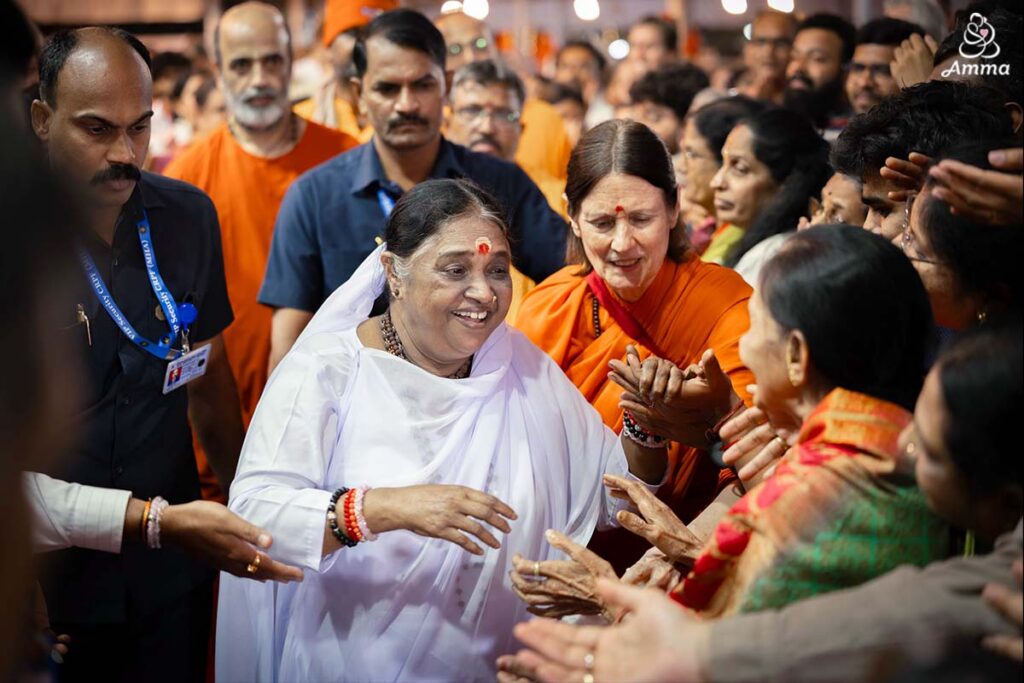
In the early hours of Monday, the festival came to a close, and the road wound down through the Sahyadri, towards the sea.
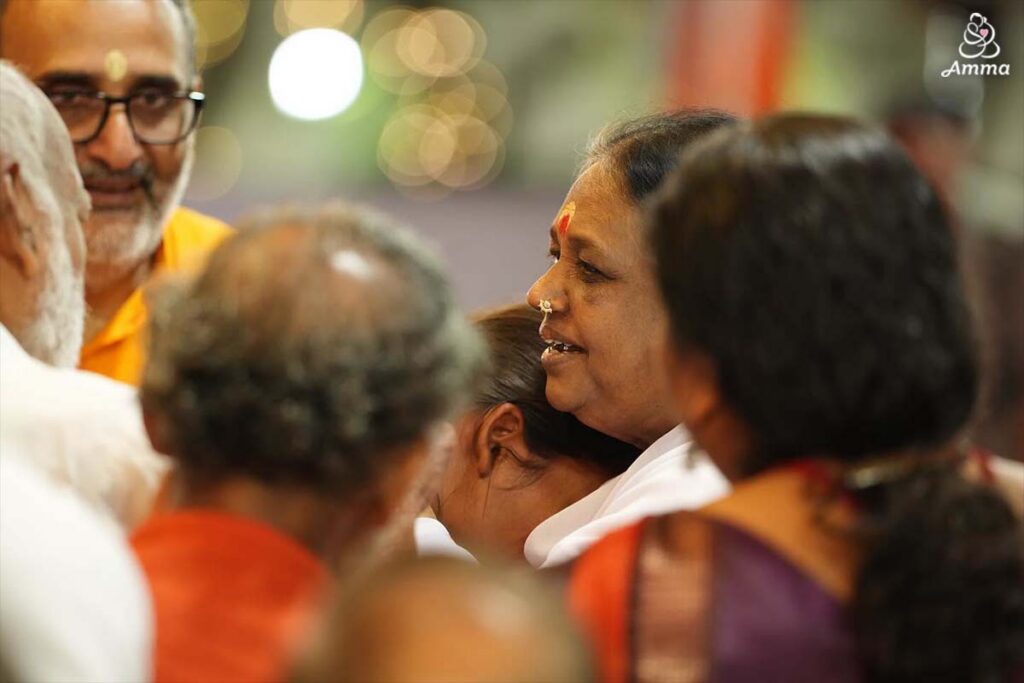
Pune is a place where devotion has travelled on foot for millennia, and where, for two days, it had only to walk to Nigdi.
A few moments with Amma leaves an eternal imprint of Grace.
Schedule for Amma’s Bharat Yatra: Oct 30‑Dec 6