


In what cardiologists are calling a major step forward for congenital heart disease management in India, four patients underwent Transcatheter Pulmonary Valve Replacement (TPVR) procedures on July 3rd at Amrita Hospital, Faridabad, without requiring open-heart surgery.
TPVR is a minimally invasive technique that replaces a damaged heart valve using a thin, flexible tube (catheter) inserted through a blood vessel, avoiding the need to open the chest surgically.
The patients, all of whom had undergone surgery during childhood for Tetralogy of Fallot (TOF), a birth-related heart condition that affects normal blood flow through the heart, had returned years later with complications from a leaking pulmonary valve.
This kind of leakage is a known long-term consequence of the initial repair. Traditionally, such cases would require another round of open-heart surgery, which comes with significant risks and extended recovery.
Instead, the cardiology team carried out the TPVR procedures using the Harmony™ Valve system, a new-generation valve made of biological tissue and mounted on a metal frame.
In a country like India, where an estimated 200,000 children are born each year with congenital heart disease and access to timely surgical care remains limited, broader adoption of TPVR could be transformative.
Dr. Sushil Azad, Deputy Head & Principal Consultant, Paediatric Cardiology
As a result of this treatment, the four patients: a 37-year-old from Delhi, a 17-year-old from Noida, a 14-year-old from Gurgaon, and a 15-year-old from Noida, were each discharged within 48 hours of the procedure, a significant reduction from the usual 10-12 day hospital stay.
“Globally, nearly 40% of patients who undergo childhood repair for Tetralogy of Fallot will require a pulmonary valve replacement within three decades,” said Dr. S. Radhakrishnan, Head & Professor, Paediatric Cardiology and Adult Congenital Heart Disease.
“In India, the vast majority of these reinterventions are still managed through conventional surgery. Transcatheter Pulmonary Valve Replacement (TPVR) offers a less invasive, faster alternative with a global success rate exceeding 95%, yet its uptake in India remains under 10%. This is largely due to issues of cost, access, and the fact that most clinical protocols here still prioritise surgical options.”
Dr. Sushil Azad, Deputy Head & Principal Consultant, Paediatric Cardiology added, “The TVPR procedure is particularly valuable for patients with prior multiple open-heart procedures or high surgical risk.
“In a country like India, where an estimated 200,000 children are born each year with congenital heart disease and access to timely surgical care remains limited, broader adoption of TPVR could be transformative.
“Integrating TPVR into standard CHD care pathways can help us deliver safer, faster, and more sustainable treatment to thousands who currently face delayed or repeated high-risk surgeries.”
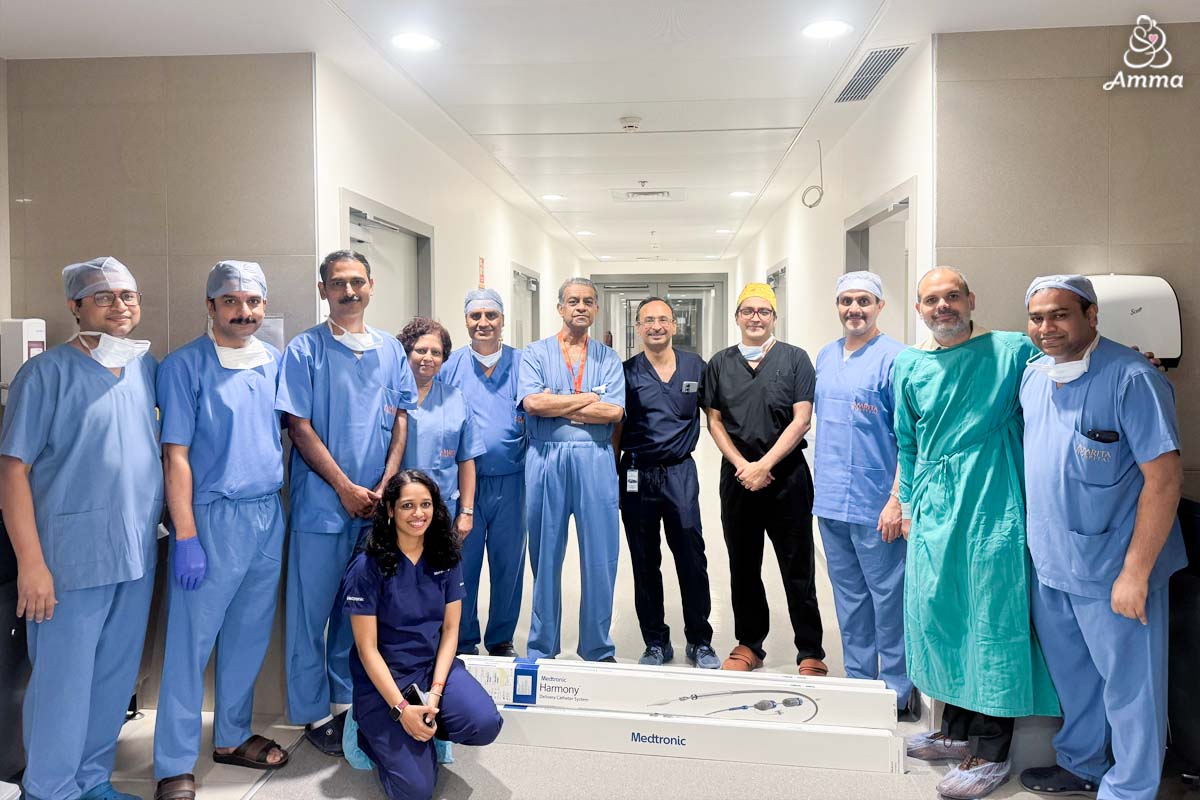
A multidisciplinary team of 5 interventional and pediatric cardiologists including Dr. Ankit Garg, Consultant, Interventional Cardiology; Dr. Savita Krishnamurthy Guin, Assistant Professor, Paediatric Cardiology; and Dr. Shashikapoor Dubbar Yadav, Assistant Professor, Paediatric Cardiology were involved in the successful procedures, with each lasting roughly 60 to 90 minutes.
Amrita Hospital is currently the only centre in India independently authorised to perform the Harmony Valve implantation without international supervision.