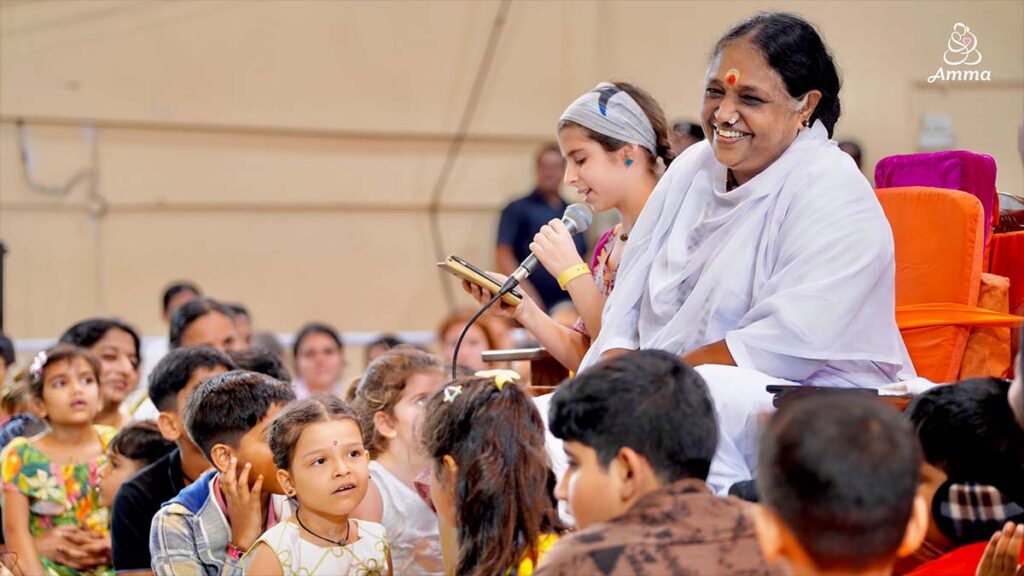




At her 2026 programme in Bengaluru, Amma spoke about how human greed is the cause of worsening environmental destruction. It is time for us to approach Mother Nature with love and simplicity.
Human beings must learn to cooperate with one another, develop a relationship of reverence and gratitude with nature, and learn to coexist with all living beings. These three principles have an impact on every aspect of our lives.
We are constantly trying to improve our lives. Yet human beings engage in conflicts among themselves in the name of communities, politics, and nations. There are divisions, disagreements and struggles.
But can we deal with nature in the same way? Can we go to war with nature? When we understand nature and recognise its greatness, we will develop humility. We will bow our heads in reverence and approach everything with a sense of simplicity and respect.
A father’s rage, a snake’s fury
Once, a father and his son were cultivating crops together in a field. The son accidentally stepped on a snake and the snake immediately bit back. The young man lost consciousness, and the father was furious. He took a sickle and struck the snake, severing its tail, but the snake managed to escape.
The father rushed his son to the hospital. The young man survived, but unfortunately, he lost one of his legs. Then, the father was consumed by rage. Wielding a knife, he relentlessly searched for the snake, seeking revenge. But as he continued, the snake bit a cow they had raised, and the cow died. Having lost even more, he paused to reflect on the situation.
When the father finally found the snake’s hole, he placed some milk there and said, “Let us forget this. Let us put it behind us. Friend, you caused my son to lose his leg. I will forgive that. Because of me you lost your tail. I trust you will forgive that too.”
The snake replied, “Because of me, your son’s leg is gone; you can never forget that. And you yourself took my tail. I cannot forget that either.”
Compassion is not weakness
This is how humankind behaves. When one person hurts another, both carry the memory of that injury; they cannot simply expect the other person to forget. But Mother Nature is not like that. When her children make mistakes out of ignorance, She forgives and forgets. For generations humans have caused Her great harm, and She has tolerated everything. But perhaps She can no longer continue in the same way.
We must never mistake Her love and compassion for weakness. Mother Nature may appear gentle, but Her power is immense. She has the ability to protect us, but She also has the capacity to punish us. Once we begin to understand this, we must approach Her with humility and reverence and make every effort to correct our ways.
The Upanishads teach ishavasyam idam sarvam (all this is pervaded by God). May there be peace in all the worlds. May we see everything as sacred, and may the gross and the subtle help us. May we hold an attitude of respect and gratitude.
Learn the language of the heart
Every living creature plays a vital role in the ecosystem. In the old days, when a bride came to her new home, she was given two cows, symbolising a life connected to nature. If the cows gave three litres of milk, the tradition was to set aside half a litre each day to share with travellers, the needy, and other creatures.
In today’s world, nature provides us with sustenance, but human greed, vikriti, takes more than its share. These distorted actions disrupt prakriti, the natural order of our world, and in turn erode sanskriti, the refined way of life that once kept us in harmony with all of creation. We have forgotten how to live simply, how to walk upon the Earth with humility, and how to preserve our shared home.
Let us return to the language of the heart, live in harmony with nature, and treat all of creation with love and respect. May the subtle and gross forces of Mother Nature help us all.
Om Lokah Samastah Sukhino Bhavantu
Om Shanti, Shanti, Shanti
May all beings everywhere be happy.
Peace, peace, peace.