


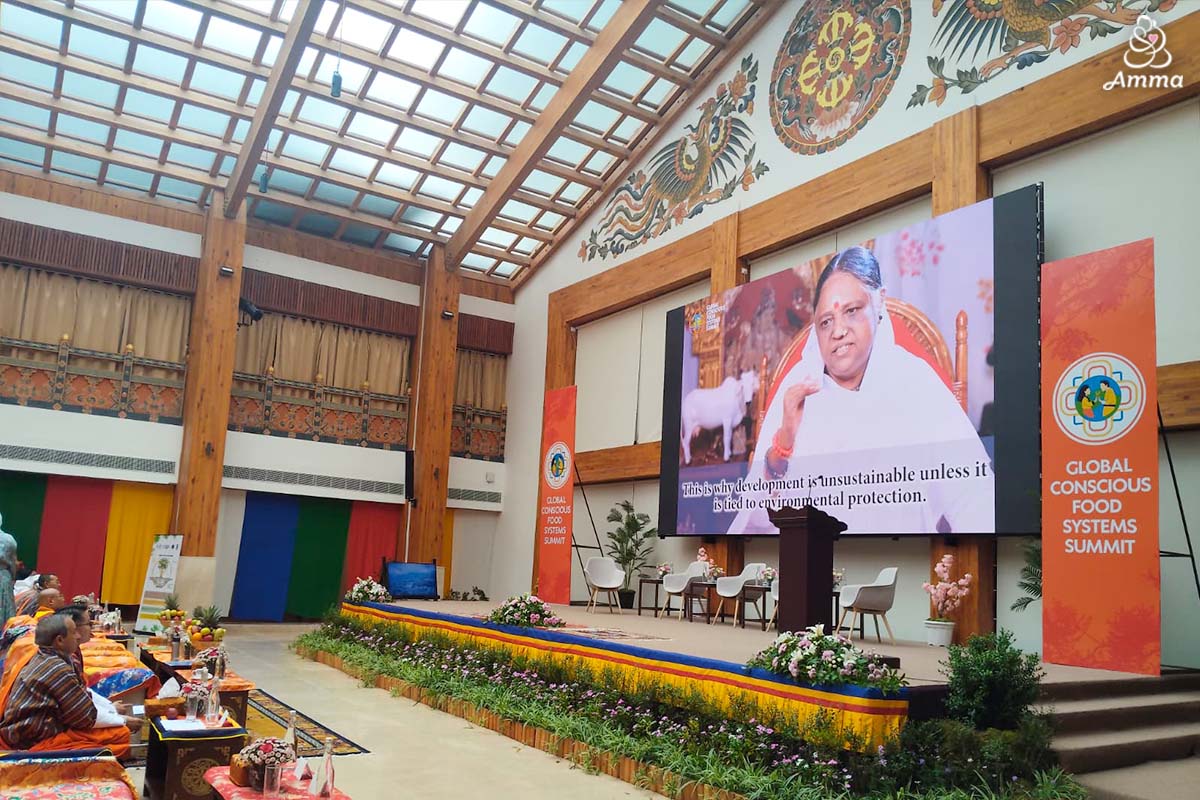
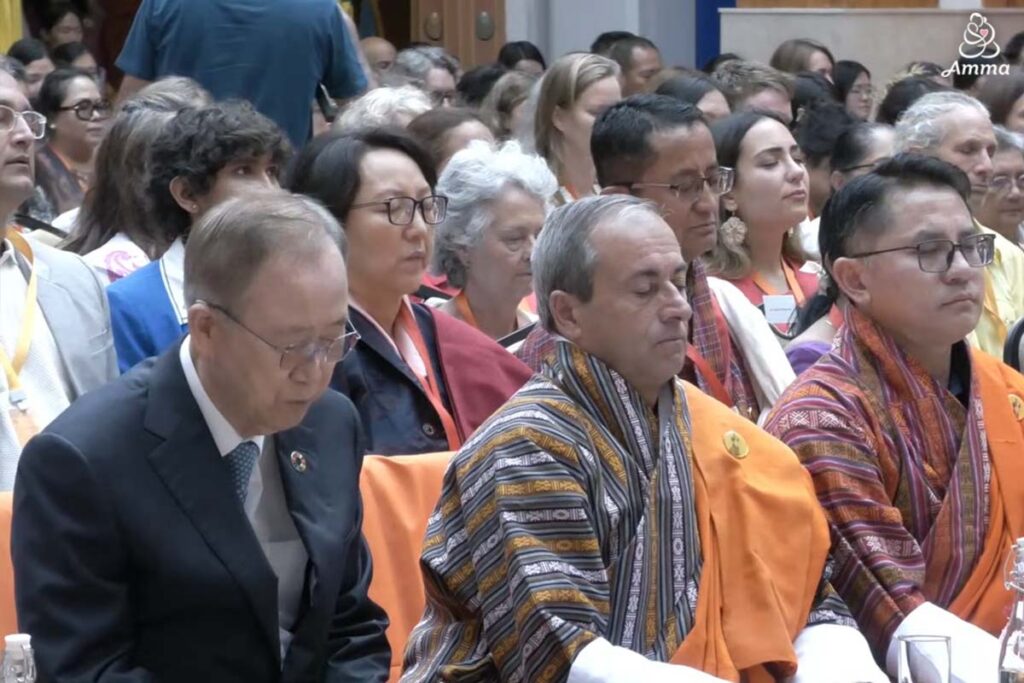
At the world’s first Global Conscious Food Systems Summit, nearly 400 delegates from 65 countries gathered in the mountain valley of Paro, Bhutan. The summit was convened by the Royal Government of Bhutan together with the United Nations Development Programme (UNDP) and the Conscious Food Systems Alliance (CoFSA).
Taking place from 31 August to 4 September 2026, it is the first global meeting dedicated to integrating consciousness, values and inner development into food systems transformation. Leaders and delegates are focusing on the contradiction at the heart of modern agriculture—the world produces more than enough food to feed everyone, yet hundreds of millions of people still go hungry.
As one of the speakers at the high-level opening, Amma was joined by Hon’ble Ban ki Moon, former Secretary-General of the UN; HE Tshering Tobgay, Prime Minister of Bhutan; and HE Harini Amarasuriya, Prime Minister of Sri Lanka.
The organisers consciously decided to invite Amma as an opening keynote speaker to share her vision as one of the world’s foremost spiritual leaders. Her humanitarian work for sustainable development aligns with the summit’s landmark goal to help transform our world’s food systems—systems that include spirituality, diverse cultures, values, happiness, and inner development.
“Humanity is facing extraordinary challenges today. If we truly want sustainable development, holding conferences and creating policies and laws alone are not enough. Humanity’s attitude has to change. The world will become good only when the mind of the individual becomes good,” said Amma in her message.
“In the coastal village where Amma grew up, 90% of the people lived off daily wages. Whatever they earned on a particular day, they would spend on food. This gave the understanding that in today’s world, people experience two types of poverty: the poverty caused by a lack of food, clothing and shelter, and the poverty caused by a lack of love and compassion.
“Of these two, the second type needs to be considered first—because, if we have love and compassion in our hearts, then we will wholeheartedly serve those who suffer from a lack of food, clothing and shelter.”
Amma’s initiatives to provide food for impoverished people throughout India began in 1995, distributing food for families in villages and slums across the country. Today, more than one crore meals are served each year. Volunteers also reach remote tribal areas, focusing on milk, rice, and other basic needs.
As well, volunteers with the Mata Amritanandamayi Math (MAM) in more than 50 countries across the world gather at their local food banks and soup kitchens. Many MAM Centres also run their own projects to provide food, clothing and other essential supplies.
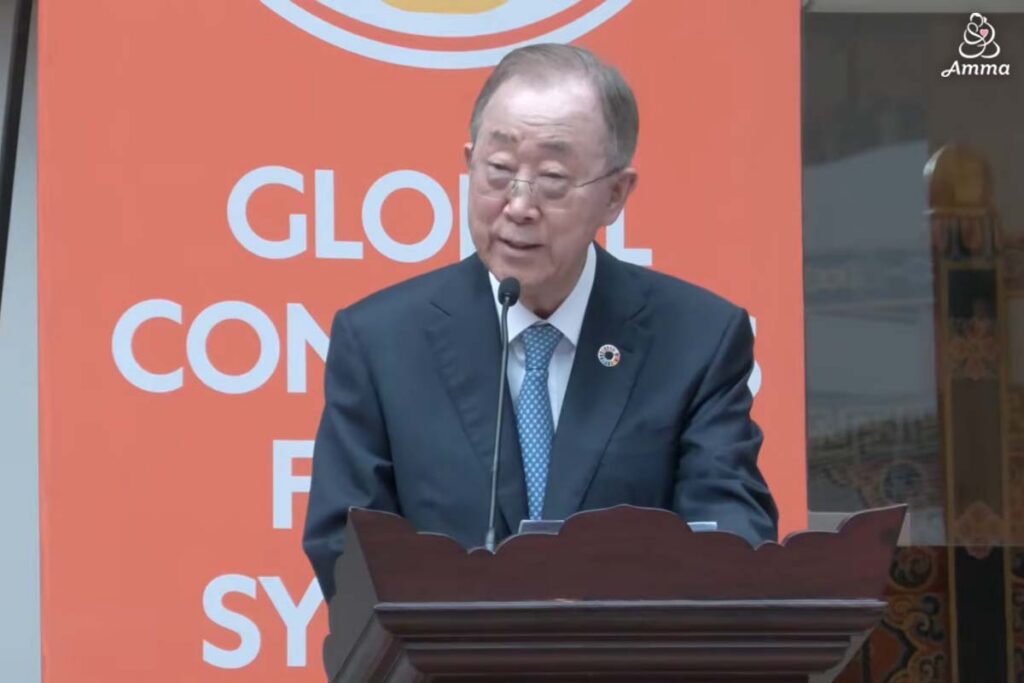
Hon’ble Ban ki Moon, former Secretary-General of the UN, expressed that humankind must recognise that finding solutions for the world’s food supply requires inner and cultural transformations.
“Food is not only a commodity. Food connects us to Nature and to communities. Food is a fundamental human right. A conscious shift in our mindset, values, and world views must be recognised as a fundamental enabler of sustainable development alongside policy, finance and technology,” he said.
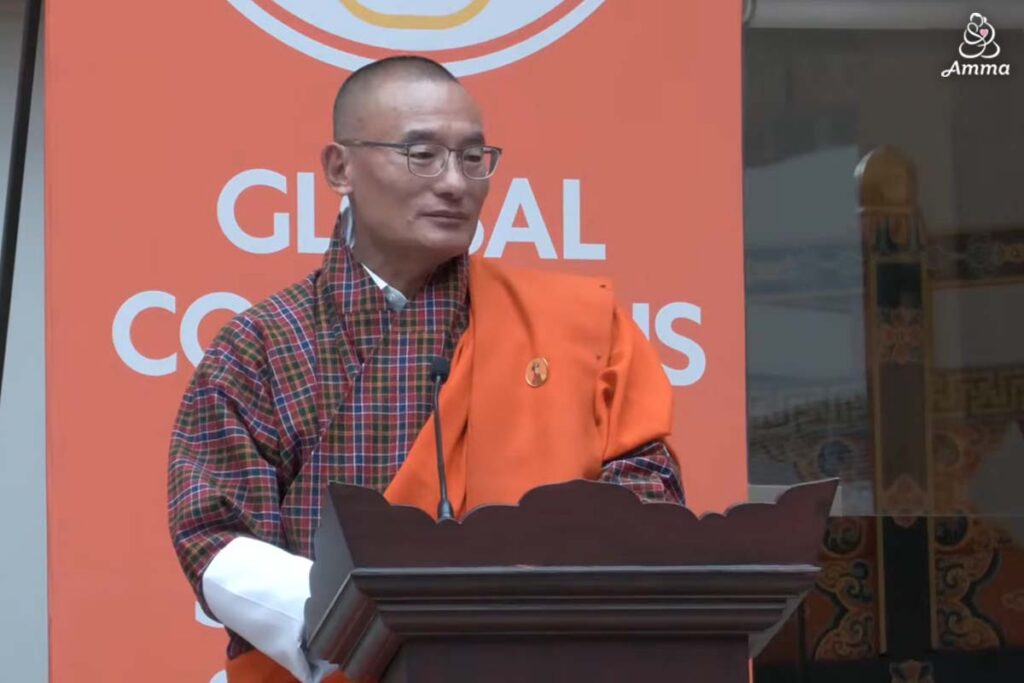
Prime Minister Tshering Tobgay explained that for Bhutan, consciousness about how food is produced and supplied must go beyond simply seeing the meal upon our plates. The purpose must go beyond producing and selling.
“For Bhutan the answer must begin with people. A food system must feed our people. It must provide our farmers with dignified livelihoods. It must create opportunities for our young people,” said PM Tobgay.
“It must protect the soil, water and biodiversity on which agriculture depends. It must be productive, competitive and economically strong enough, resilient enough to endure. These objectives cannot be pursued separately. This is where consciousness must move from a way of seeing to a way of acting.”
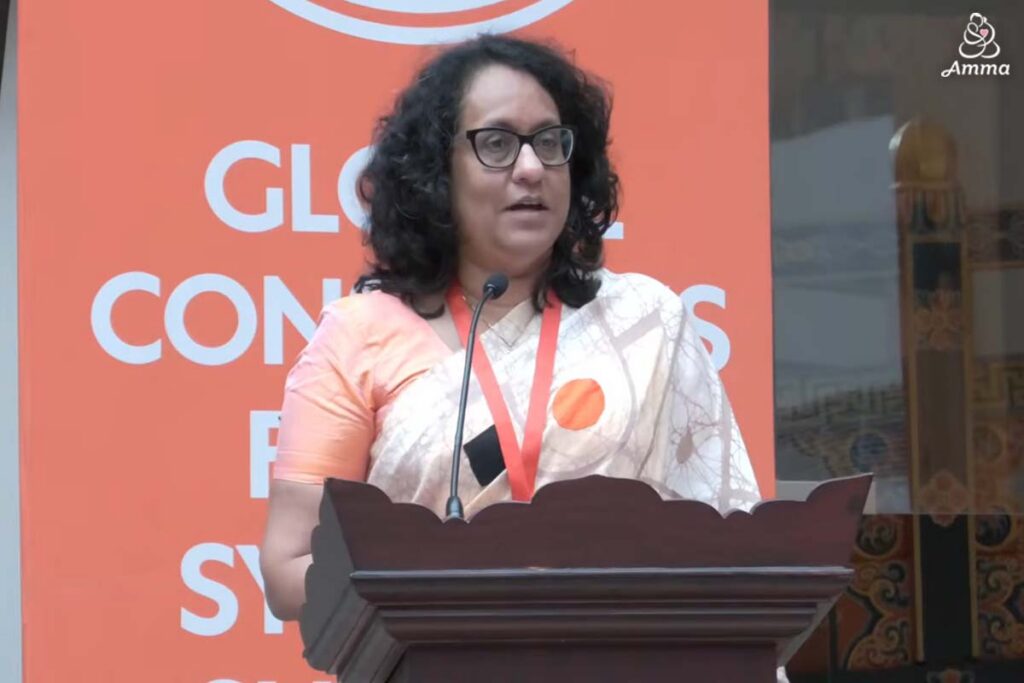
HE Harini Amarasuriya, Prime Minister of Sri Lanka, said that although the economies in many countries have grown, so has inequality, environmental damage, and the erosion of values such as ethics, solidarity and compassion. She stressed the need to solve our world’s increasing food crises by using modern science in union with traditional knowledge.
“Food connects almost all dimensions of this crisis, be it climate, water, health, livelihoods, inequality, biodiversity, and human wellbeing. Food loss can be reduced through strengthening climate resilience,” she said.
“Farmers can be supported while protecting soil, water and biodiversity. It reminds me of something that I read recently: ‘Do not seek to step in the footsteps of the wise, seek what they sought.’”

Over the following three days, the summit’s participants will work on a Framework for Conscious Food Systems, complemented by deep reflection circles, meditation, mindful food rituals and site visits to Bhutanese farms and communities.
The Govt of Bhutan places psychological, cultural and ecological wellbeing alongside economic progress, and its largely organic, Nature-friendly agriculture offered delegates a working example of what culture and spirituality can do for a food system.
The summit’s resulting policy recommendations will be carried into national food systems pathways and global policy processes, with the aim of embedding inner transformation into food, nature and climate agendas. Between Amma’s message from Amritapuri and the terraced fields of the Paro Valley, the Summit’s opening made its case through both concepts and examples.
Amma’s Message
Amma bows down to all who are embodiments of pure love and the Supreme Self.
Humanity is facing extraordinary challenges today. In our haste to find solutions to the problems of the world, we often look only to the external world. We forget that the source of many of these problems lies within the human mind. The world will become good only when the mind of the individual becomes good. Therefore, along with an understanding of the outer world, it is essential that we also come to know our inner world.
The human body, along with everything sentient and insentient in this world, is comprised of five elements — earth, water, fire, air and space. These five elements originate from Nature. This is why humankind and Nature are one. Knowing this truth through direct experience, the ancient sages of India declared vasudhaiva kuṭuṁbakam—“The world is one family.”
Humankind has the wrong understanding that Nature is our obedient servant and insentient, and hence we can treat Her however we please. However, the truth is that Nature is a unified body—a single entity. This is why development is unsustainable unless it is tied to environmental protection.
There is a rhythm to everything in creation, an undeniable relationship between the entire universe and every living creature within it. The universe is like a vast interconnected network. If a net is shaken in one place, the vibration will be felt throughout.
Similarly, whether we are aware of it or not, all of our actions—whether performed as an individual or as a group—reverberate throughout creation. We are not individual islands but links of a common chain. If we wait for others to change, nothing will ever happen. We should try to change first. Then others will follow our example.
Humankind has the wrong understanding that Nature is our obedient servant and insentient, and hence we can treat Her however we please.
Amma
In the coastal village where Amma grew up, 90% of the people lived off daily wages. Whatever they earned on a particular day, they would spend on food. Amma remembers an incident in this context.
The head of a family with eleven children could not find work for a couple of days. Seeing his children suffer from hunger, the father walked ten kilometres to borrow some money, but was unsuccessful.
On the way back, he saw a turtle coming ashore to lay eggs. From among the hundreds of eggs, he took half and fed his children. When one of them asked why he had not taken all the eggs, the father replied, “If I lost all my children, how would I feel? The turtles will be affected in the same way. And if I take all the eggs, the turtles will become extinct very soon.”
Even while experiencing pain, he was able to show compassion to other beings. If we truly want sustainable development, holding conferences and creating policies and laws alone are not enough. Humanity’s attitude has to change. If we can change our attitude, we can change our surroundings.
When Amma was a child, during the pilgrimage season, one of the activities in our village was providing food for the poor. Once my mother asked me to collect about 50 leaves for serving the food. Near a tree, I found a fallen branch with about 500 leaves on it and dragged it home. My mother became furious and scolded me, “Why did you waste 500 leaves when only 50 were needed?”
Amma understood that my mother was teaching me an important lesson: every leaf has its own purpose and lifespan, and taking more than what is needed is a form of harm. She also wanted me to learn that we should take only what we need, rather than taking more simply to satisfy our desires.
Our ancestors used to worship trees as divine beings. In my childhood, I saw people pray for forgiveness beneath trees before cutting them for any purpose. This was their way of showing gratitude for what had been provided to them. Without connecting to Nature and without her blessings, holistic well being is impossible.
There is a rhythm to everything in creation, an undeniable relationship between the entire universe and every living creature within it.
Amma
One thing is clear: If we want a lasting solution to the atrocities humankind faces today and will have to face in the future, we should be willing to change our internal climate. What is happening in the external environment—be it global warming or climate change—is but a reflection of the harsh climate in our minds.
Nature is our first mother. She nurtures us throughout our lives. Our birth mother may allow us to sit on her lap for a couple of years, but Mother Nature patiently bears our weight throughout our entire lives. Just as a child has an obligation to his birth mother, we should all feel an obligation and responsibility towards Mother Nature. If we forget this responsibility, it is equal to forgetting our own self. If we forget Nature, we will cease to exist, for to do so is to walk towards death.
In today’s world, people experience two types of poverty: the poverty caused by a lack of food, clothing and shelter, and the poverty caused by a lack of love and compassion. Of these two, the second type needs to be considered first—because, if we have love and compassion in our hearts, then we will wholeheartedly serve those who suffer from a lack of food, clothing and shelter.
May our acts become a noble ideal for those who will come after us. May the tree of our life be firmly rooted in the soil of love. May our good actions be its leaves. May our kind words be its flowers. May peace be its fruits. May this world grow and prosper as one family, united in love.
May we realise a world where there is endless peace and harmony. May divine grace bless us all. Amma offers her loving prayers and best wishes for the success of the Global Conscious Food Systems Summit.