


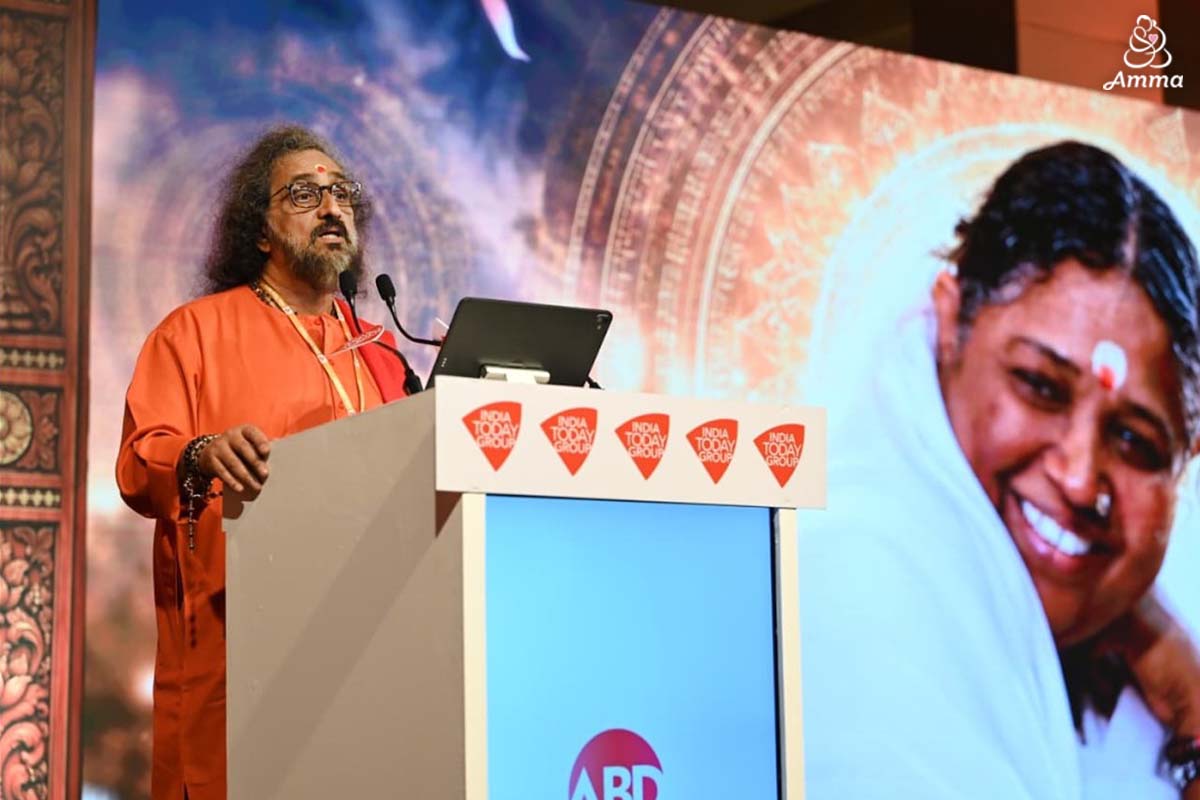
Swami Amritaswarupananda Puri, Amma’s most senior disciple, addressed the annual India Today Conclave South on September 30, 2026. The regional gathering took place in Kochi, Kerala, and focused on South India’s expanding economic, technological and social leadership. Swamiji spoke about the most vital need of all—bringing peace to a world where conflicts are on the rise.
Swamiji’s Address
When I first saw the title of this session, peace in a broken world, my first question was, who broke it? And is it still under warranty? Unfortunately, the warranty expired somewhere around the stone age and there is no customer care number. So I’m afraid we will have to repair it ourselves.
I won’t begin with the definitions. If we start asking what is peace and who broke it, we will still be debating at dinner time and peace will be the first casualty, especially if dinner is late.
So those are good questions but they can also become a clever way of avoiding action. So let us look honestly at what is wrong and then ask the most practical question of all. What can each of us actually do?
Perfect peace is unattainable
Some of what I say may be uncomfortable. Please take it as an offering not as a verdict. We often equate peace with nonviolence. This is just one of the many dimensions of peace. But let us consider the nonviolence aspect of peace.
The Mahabharata says ahimsa paramo dharma. Nonviolence is the supreme dharma. And Jesus Christ taught us not to repay harm with harm, saying, “Turn the other cheek and love even your enemies.” The Quran says, “The servants of the most merciful walk gently on the Earth, and when the ignorant speak harshly to them they reply peace.”
Beautiful, aren’t they? Almost every great tradition places nonviolence at the very top.
Our world is cracked. We cannot pretend otherwise, but we can choose what fills the cracks.
Now let me ask you something. Most of you here believe in some sort of philosophy or uphold some ideal or virtue. But how many of us actually live by these teachings? I won’t ask for a show of hands, partly out of respect and partly because I don’t want to be the only one whose hand stays down.
Besides, I can already hear your thoughts whispering. Try turning the other cheek to the man who just overtook you from the left and then honked at you.
So, let us be honest. Can any individual, any nation, any leader, any political party be completely pure, completely truthful and completely nonviolent? The answer is no. And if 100% nonviolence is impossible, then perfect peace is also an unattainable ideal.
Then what is realistic?
Peace in this world can only ever be relative. We need to accept this before any conference, dialogue or brainstorming begins. Otherwise, we are simply chasing a mirage with a PowerPoint.
So what is practical? Respect. That we respect what unifies us as humans. Respect diversity. Respect nature. And respect every individual’s right to exist and achieve their full potential. Or put in simple terms, live and let live. If the whole world followed just this one rule, half the wars, most family feuds, and every WhatsApp group fight would end by tomorrow morning.
No one won the Mahabharata War
Let me remind you of four wars. The first is the Mahabharata War. You may think it is
a myth. Still it conveys something, a profound message. It broke out only after every path to peace had closed, and Lord Krishna himself went as a peace emissary and asked for just five villages for the Pandavas, five villages.
Duryodhana, the original not-one-inch-negotiator, refused to give even as much land as the point of a needle could pierce. With that he shut the door on reconciliation and chose war. When the dust settled only eight warriors survived on the Pandavas’ side and four on the Kauravas’ side.
The war was fought for a dharmic cause, but if we ask who won, the answer is no one. The Pandavas, of course, ruled the country righteously for 36 years. Yet their victory was shadowed by a grief that never fully lifted.
Victorious Emperor Ashoka apologised
The second war is the Kalinga War fought by Emperor Ashoka around 261 BCE. Ashoka won at a terrible cost, and in his own rock edict 13, he records that about 100,000 people were killed, 150,000 deported, with many more dying afterward.
And then he did something extraordinary. He publicly expressed remorse. He may be the only ruler in history to publish an apology carved in stone. Today’s leaders usually issue a clarification that their statement was taken out of context. Ashoka declared that the only true conquest is by dharma not by arms and urged his descendants to give up war.
Operation Sindoor: A measured response
The third is, sorry, I know many of you will disagree, the third is Operation Sindoor. Here I will not joke. When an adversary repeatedly sends infiltrators, sponsors terrorism, and kills innocent civilians, does the government not have a duty to respond?
Views may differ, but unlike so many conflicts raging today, Bharat delivered a measured response and then chose to halt hostilities before they could escalate into full-scale war. And still we must remember, we must never forget the families who watched their loved ones gunned down before their eyes. Their grief did not end with the ceasefire.
Four wars, one grief
The fourth war is the one happening right now. Born out of human greed and ignorance. Whether a war is dharmic or adharmic, for a good cause or a bad cause, in the end we come to see that it was fought for nothing more than a hollow crown.
Based on the nature of the four wars, each letter in wars—W-A-R-S—can be expanded as follows:
W – Woe. The Kurukshetra War. The war at Kurukshetra was perhaps inevitable. The Pandavas won, yet it ended in deep sorrow for everyone, both winners and losers.
A – Awakening. Kalinga War. The Kalinga war caused terrible destruction, yet it changed Emperor Ashoka’s heart.
R – Response. Operation Sindoor. Operation Sindoor showed the enemy that we will no longer stay silent, and that our patience should never be mistaken for weakness.
And the last, S – Selfishness. The wars of today serve only one purpose—to satisfy the greed of a few—a section of society, while ordinary people pay the price.
In short, woe, awakening, response, and selfishness. Four wars, four different outcomes, yet the end result is grief.
Einstein put it memorably, “I know not with what weapons World War 3 will be fought, but World War 4 will be fought with sticks and stones.”
We have wars raging on multiple fronts, some that attract the attention of the world, and some others that burn quietly within their own boundaries. Be it Ukraine, Gaza, Sudan, Congo, or at our own borders.
No war stays where it began
If war is a sign of malaise, is there a cure? When a doctor treats a patient, the doctor is an unaffected individual and for the most part treats an ailment where the root cause is an organism alien to the patient’s body.
But what if the ailment was systemic much like autoimmune diseases and what if the doctors are patients themselves? How can we make an unbiased diagnosis? What treatment would we recommend when we are the cause and solution? What kind of treatment would address the flare without destroying the other parts of oneself?
Let us try to look at systemic problems and not start with pinning blame. What do all these crises have in common? None of them stays where it began. When a ship is wrecked or attacked in the Strait of Hormuz, the auto rickshaw driver in Thrissur pays for it at the petrol pump. A war far away becomes a fuel shortage, a refugee crisis, or a rise in the food prices right here in Kerala.
Positive peace, negative peace
War shatters and shrapnel spreads beyond its boundaries. But I believe peace can spread too. The peace scholar Johan Galtung gave us a useful distinction. Negative peace is the absence of violence, when the guns fall silent. That matters enormously because children can sleep again.
Positive peace is the presence of justice, dignity, and fairness. A society can be free of war and still not be at peace if people are hungry, humiliated, or excluded. Negative peace without positive peace is like a pressure cooker with a whistle blocked. It stays quiet for a while and then everyone in the kitchen finds out at once. So peace is not passive.
Candlelight, vigils, and good wishes have their place. But peace also needs planning, fair laws that are actually enforced, and ordinary people willing to act. Peace is too important to be left only to idealists. It is everyone’s work.
Calm is a greater challenge than war
Now comes the hardest part. Looking at ourselves. We find it very easy to say to others, “You can do nothing right.” And to ourselves, “I can do nothing wrong.” That habit of mind is where conflicts begin.
Look at our own society. Caste discrimination has not disappeared. Violence against women has not disappeared. I know that too often, instead of confronting these wrongs, we explain them away, sometimes even in the name of tradition or dharma. And true dharma never needs excuses for injustice.
We also see forces feeding conflict everywhere. Violence tolerated for short-term gain. Voices that teach suspicion of the other. Media that reward outrage because outrage gets ratings. And alcohol and drug abuse that fuel violence at home and on the streets.
Peace is too important to be left only to idealists. It is everyone’s work.
With the advent of social media, everyone is suddenly a pundit, a scholar, switching sides as it suits them. And with AI thrown into the mix, we now find it increasingly difficult to separate truth from lies. Don’t we feel that we are living in a fictitious world?
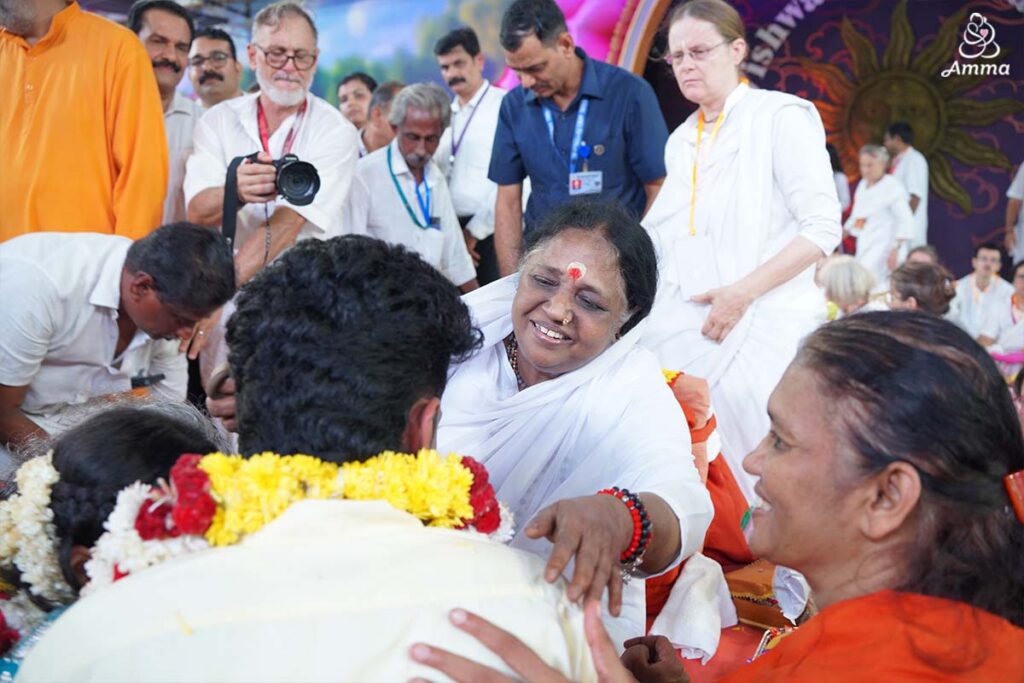
Others have no opinion simply because they don’t care. And beneath all of it are the quiet ones, the greatest among us, who see, say, and work tirelessly, one person at a time, one hug at a time, towards peace.
Even for a few moments, when calm settles over, a restless thought creeps in. Most of us ask, “Why am I so calm? Shouldn’t I be worrying about something?” It’s a challenge. Calmness.
War, on the other hand, excites us. Our elections are fought like battles, and whether it is a real war or an election, news anchors, reporters, and viewers can barely hide their thrill. For those who watch TV, it’s quite obvious. I sometimes suspect that if peace suddenly broke out, a few news channels would suddenly have to shut down for lack of content.
Outer wars begin with inner wars
So when we talk about peace in a broken world, we must ask a deeper question. Are we at peace with ourselves? Because a person at war inside will eventually find someone outside to fight.
UNESCO’s founding charter says it beautifully, “Since wars begin in the minds of men, it is in the minds of men that the defences of peace must be constructed.”
And the Bhagavad Gita said it thousands of years earlier:
नास्ति बुद्धिरयुक्तस्य न चायुक्तस्य भावना ।
न चाभावयतः शान्तिरशान्तस्य कुतः सुखम् ॥
nāsti buddhir ayuktasya na chāyuktasya bhāvanā
na chābhāvayataḥ śhāntir aśhāntasya kutaḥ sukham
Chapter 2 verse 66: One whose mind is not disciplined has neither wisdom nor contemplation, and without contemplation there is no peace, and without peace how can there be happiness?
When foes became allies
When did we last hear our public figures speak of peaceful coexistence? Let me remind you of 1994. Pakistan moved a resolution against India on Kashmir at the UN Commission on Human Rights in Geneva.
The then Prime Minister P.V. Narasimha Rao of the Congress asked Atal Bihari Vajpayee, then leader of the opposition from the BJP, to lead India’s delegation. He was joined by Farooq Abdullah of the National Conference and Salman Khurshid of the Congress.
Three parties that fought each other fiercely at home stood together abroad and Pakistan withdrew the resolution. Imagine that today. Most of our parties can’t even agree on the seating arrangement. Civility is not weakness.
Weapons rule over welfare
How we speak shapes how we think, and how we think shapes what we do. Before the first shot is fired in any conflict, have you ever noticed there is usually a war of words, a rumour, an edited video, an angry post forwarded a thousand times?
Each of us carries in our pocket a weapon of mass distraction. It can spread suspicion, or it can spread understanding. The choice is ours. So every time we press ‘forward’, think deeply.
Gandhiji reminded us that the Earth provides enough for everyone’s needs, but not for everyone’s greed. Look at how the world chooses to spend. In 2025, global military spending reached about $2,887 billion.
In the same period, aid from wealthy nations to poorer ones fell by around 23% to about $174 billion. And for every dollar spent helping the poorest, more than 16 are spent on arms. If we spent on peace what we spend on weapons, peace might finally become affordable.
Facing the reality on the ground
And look at what aid can do. In Sudan, UNICEF and its partners treated 174,700 children for severe malnutrition and vaccinated 3.8 million against measles, even as they faced a 64% funding gap. Imagine a doctor who knows exactly how to save a child and simply doesn’t have the medicine.
President Eisenhower himself, a celebrated general, warned about the military-industrial complex. His point was not that nations should be defenceless. It was that when conflict becomes profitable, the incentives for peace grow weaker.
International order depends on trust, and trust depends on consistency. And when rules seem to apply to some nations and not to others, the rules lose their authority. Civilians, hospitals, and aid workers must be protected no matter who is fighting.
Tomorrow’s wars may well be fought over water, land, and food.
In Sudan alone, the World Health Organization has verified 201 attacks on health care with 1,858 people killed. Hostage-taking, targeting civilians, using civilians as human shields, using rape of women and children as a strategy of war, blocking food and medicine. These must be condemned wherever they happen and whoever commits them. The same consistency matters for nuclear weapons and for climate.
Tomorrow’s wars may well be fought over water, land, and food. Delaying climate action today is a risk to peace tomorrow. And India, our country, has responsibility here. As the world writes new rules for trade, finance, artificial intelligence, and data, India should bring its own voice early, thoughtfully, and confidently rather than simply following others.
Peace remains a powerful weapon
Enough about problems. Despair is a luxury we cannot afford. So what works?
First, keep talking to those on the other side who are willing to listen. Every country has within the just lovers of humanity, the lovers of peace. Peace can only be brokered by them.
Armenia and Azerbaijan, after decades of conflict, signed a peace agreement in 2025. Mediation is slow and unglamorous. But it is the only thing that has ever ended a war without destroying the people caught in the crossfire.
Every country has within the just lovers of humanity, the lovers of peace. Peace can only be brokered by them.
Second, follow-through. The Democratic Republic of Congo and Rwanda signed an agreement in 2025, and the fighting continued. But they kept meeting, and this August, agreed to stronger monitoring on the ground, ceasefires, and referees. They need not just ceasefires but referees, not just signatures.
Third, rebuild. A peace that leaves people homeless, jobless, and hopeless is a peace waiting to collapse. Rebuilding homes, schools, and hospitals is not charity. It is conflict prevention.
Fourth, protect those who keep people alive. In Sudan, neighbourhood volunteers running community kitchens have fed people where no international agency could reach.
Fifth, pursue justice with healing and compassion. Courts and investigators preserve the truth and truthtelling, but reconciliation must strive to ensure that one generation’s pain or humiliation doesn’t become the next generation’s burden or revenge.
Are peace talks truly seeking peace?
Now a small confession. I have attended many peace and interfaith conferences in India and abroad. Wonderful food, excellent photographs, good accommodation, and beautifully worded joint statements. But I sometimes came home wondering whether peace itself had attended. Too often these gatherings lack depth and serve political purposes more than peaceful ones.
Our own scriptures are far more honest, I would say. The Ramayana and the Mahabharata, the Dharma shastras, don’t glorify war. Nor do they pretend it can always be avoided.
Lord Rama sent Angada to give Ravana one last chance. And even when Ravana lost his chariot, his weapons, and he stood weaponless in the battlefield, his whole body wounded, bleeding, Rama went up to him and said, “You are tired, exhausted, and you are weaponless. You’re completely disarmed and it is adharmic to kill a person who is unarmed. Go back, rest, and come tomorrow.”
Krishna went personally to plead for peace. War was the last resort, never the first, and even then, it had to be fought with restraint.
If no one can, you must
Some of you may be thinking, I’m not a diplomat. I cannot negotiate ceasefires. There is a saying often called a Japanese proverb: “If one can do it, you can do it. If no one can do it, you must do it.” Around the rest of the world, it seems to have been quietly revised: “If one can do it, let him do it. If no one can do it, well, what can I possibly do?”
In the modern global edition, if one can do it, form a committee to review it. If no one can do it, hold a summit, issue a joint statement, and schedule another summit. And the social media version, if one can do it, share his video. If no one can do it, post, someone should really do something and wait for the likes.
So somewhere between “you must do” and “what can I do?”, lies the entire story of why the world’s problems stay unsolved.
Grieve every innocent life equally.
So here is what we can actually do. Try to understand both sides of the conversation. Speak up against injustice that happens near us, not only when it happens far away. Disagree without insulting, before forwarding anything about a conflict.
Ask three questions. Is it true? Is it fair? Will it help people understand each other? Remember the crises the world forgets like Sudan, the Sahel and Congo, and give regularly, however little.
Grieve every innocent life equally, and practise peace at home. Apologise when we are wrong. Forgive when we can. Build one friendship across a line of religion, language, or opinion. And truly listen, because war stirs up our fear and anger, and pushes us to cast one side as the villain and the other side as the hero. We see the world in black and white when life is painted in countless shades of colour.
Simplicity takes courage
Life’s principles are actually very simple. As the famous economist E.F. Schumacher said, “Any intelligent fool can make things bigger, more complex, and more violent. It takes a touch of a genius and a lot of courage to move in the opposite direction.”
Amma speaks of two kinds of education, “Education for a living and education for life. Becoming a doctor, engineer, or manager is education for living. Understanding the mind, the world and the essential values of life is education for life. Both must be integrated so that education imparts a culture of the heart.”
Perhaps what the world needs most is not another summit, but that kind of education. So before you think, speak, or act, ask yourself one question, “Will this bring more peace or less within me? In my family, my community, my country and the world?” If the answer is less, stop, and if it is more, go ahead with courage.
Become the gold in the cracks
In Japan, there is an art called kintsugi. When a precious bowl breaks, it isn’t thrown away. It is mended with gold. And the cracks become the most beautiful part of the bowl. Our world is cracked. We cannot pretend otherwise, but we can choose what fills the cracks.
Indifference and fear, or gold? The gold of compassion that feeds the hungry. Patience that keeps people talking. Fairness that protects every life equally. And truth that outlasts rumour.
The world was broken by human beings, and it can only be mended by human beings. Not someone else. Us. Starting today.
Amma says, “When we see the darkness before us, we may wonder how to cross it. Each of us is like a small candle. A single candle cannot vanquish the darkness. But if all our candles come together, there is no way we cannot triumph.”
Let us be the candles. Let us be the gold in the cracks.
ॐ अमृतेश्वर्यै नमः
Aum Amriteshwaryai Namah